Daggerheart ancestry: Halfling. Player-facing.
OVERVIEW
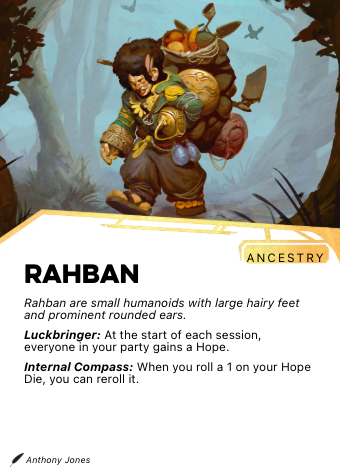
Rahban (Halfling) are small, rounded humanoids with notably large feet, prominent ears, and an internal sense of direction that functions regardless of weather, terrain, or how long it has been since they last knew where they were. Their average height runs from 3 to 4 feet. Their feet — hairy and broad — give them a stability on irregular terrain that larger peoples sometimes envy. They live for around 150 years, maintaining a youthful appearance well into late adulthood.
Their internal compass is not metaphor. Rahban are magnetically attuned to their world in a way that means they do not get lost. This has made them sought-after as guides and navigators across Tarim-Shaiel, though Rahban themselves tend to be skeptical of the value others place on this ability — to them, it is simply knowing where you are, which seems basic.
Rahban communities are generally close-knit and intentional. They form strong bonds, maintain those bonds across distance, and treat the care of a community as a form of craft. Rahban who travel widely are rarely people who have abandoned community; more often, they are people who have expanded their definition of who counts.
Ancestry Features
Rahban treat the care of a community as a form of craft, and there is something in their presence — in how they attend to the people around them, in how they create the conditions for things to go right — that other peoples notice and benefit from. Parties that include a Rahban tend to start their days a little better resourced than they expected.
Rahban are magnetically attuned to their world in a way that means they do not get lost. This is not metaphor. Their internal compass functions regardless of weather, terrain, or how long it has been since they last knew where they were. To a Rahban, this seems basic. To their traveling companions, it is frequently invaluable.
HISTORICAL POSITION
Before the Liberation
Rahban were not among the peoples who were systematically enslaved. They were too distributed, too embedded, too useful to the machinery of empire to make compelling targets for the binding spells that held the Tulpar in place. They operated as merchants, contract-keepers, couriers, and minor diplomats within the imperial system — present everywhere, concentrated nowhere, holding the connective tissue of commerce together across vast distances.
This position is not simple. Some Rahban communities benefited materially from imperial stability. Others quietly worked against it — sheltering people, moving information, creating the small conditions that made larger movements possible. Most did both simultaneously without finding the contradiction unbearable, because Rahban ethics tend toward the practical: what can be done for the person in front of you, right now, with what you have.
When the liberation came, Rahban were not its authors. They were not its warriors. What they were was present — which turned out to matter enormously in the years that followed.
The Aftermath: The Work Nobody Sang About
The chaos that followed the liberation — the decades of displacement, violence, and fragmentation historians call the Blood Years — is remembered by most peoples through their own experience of it. The Tulpar remember survival and the slow discovery of selfhood. The Kuhban remember sealing their passes. The Serenvar remember accelerating their withdrawal.
Rahban remember it as work.
When liberated Tulpar populations were starving, scattered, and directionless, Rahban communities began appearing at the edges of conflict zones with food, routes, and the one thing no one else was offering: willingness to talk to all parties without declaring allegiance to any. The Rahban did not have an agenda for what the post-imperial world should look like. They had an agenda for whether people would eat this week. These turned out to be complementary positions.
The Truce of Nine Caravans — the first multi-species trade agreement that established protected corridors through the wreckage — was negotiated over three months at a Rahban waystation. The Rahban hosts fed everyone, kept the parties separated when they needed to cool down, and sent a Rahban child to carry messages between rooms because no one was willing to walk down the hall themselves. The child's name is in the Rahban oral record. The diplomats who signed the Truce are in everyone else's.
This is characteristic. Rahban contributions to the world's history are frequently underdocumented because they operated in the margins of other peoples' stories — the waystation that kept the negotiation alive, the courier who carried the letter that changed the course of something, the community that quietly sheltered the people who went on to do notable things. Rahban oral tradition tracks these contributions with precision. Everyone else's records tend to begin with the notable thing.
The Flowering and the Long Peace
As the world stabilized into the era historians call the Flowering, Rahban communities became the connective tissue of the Silk Road's commercial and diplomatic life. Not its center — Rahban have never sought to be its center — but its infrastructure. The Rahban League, a loose commercial association without central authority or formal governance, formalized the trade protocols that Rahban communities had been maintaining informally for generations. It is not a government. It functions better than most governments because it has no interest in being one.
Rahban diplomatic services developed in parallel: not the high-prestige arbitration academies of the Tulpar, but the unglamorous work of maintaining relationships between parties who distrust each other across years and decades. A Rahban diplomat's career is measured in relationships sustained, not agreements signed.
Over the thousand years since the liberation, Rahban have developed a particular relationship to time that other 150-year peoples don't share in quite the same way. A Rahban who lives to old age will have known five or six generations of human families. They maintain those relationships across the generational transitions — attending the funerals of people whose grandparents they introduced themselves to, carrying news of what someone's ancestor was like to someone who never knew them. This makes Rahban community elders unusual repositories of social history: not archives, but living memory of relationship rather than event.
CULTURAL CHARACTERISTICS
The Craft of Community
Rahban communities do not form by accident. They are built, maintained, and repaired with the same attention to craft that a Kuhban brings to stonework. The specific practices vary by region and lineage, but the underlying orientation is consistent: a community is something you make, every day, through small acts of attention.
The Open Table is the most recognized of these practices — a place setting kept ready at every Rahban household for unannounced guests, travelers, or community members who need feeding. It is not charity; it is infrastructure. A Rahban community with an open table is one where people don't go hungry quietly, because the table makes the asking unnecessary.
Long correspondence is another. Rahban who travel maintain written or oral correspondence with their home communities at a frequency that other peoples sometimes find baffling — monthly letters to someone three months' travel away, sent by any available courier, answered when possible. The correspondence is not primarily informational. It is relational maintenance, the equivalent of sitting in the same room.
The Compass and What It Means
Rahban discuss their internal compass less than other peoples discuss it on their behalf. To a Rahban, knowing where north is feels roughly as remarkable as having functional eyesight — a basic capacity, useful, and not especially worth commenting on.
What Rahban do discuss is the subjective experience of the compass in unfamiliar places: the slight wrongness when it doesn't match the map, the specific sensation of being somewhere they've never been but knowing with certainty which direction home lies. Elder Rahban sometimes describe a secondary quality — less magnetic, more social — of knowing, without counting, who in a group is close to the edge of what they can handle. Whether this is a real secondary sense or a form of learned attention that mimics one is a question Rahban communities find interesting but not urgent to answer.
Debt as Relationship
Rahban economic practice is formally documented in contracts but operated through relationships. A Rahban merchant who owes you doesn't just owe you a sum — they owe you a relationship that includes the sum. Payment of the sum alone, without acknowledgment of what the relationship means, is considered a form of slight. This creates Rahban commercial networks that are difficult to enter but very difficult to exit: the obligations compound into something resembling kinship, which was always partly the point.
This practice is sometimes mistaken for obligation-exploitation by peoples who don't share it. The Rahban interpretation is different: if a debt can be reduced to its material terms and discharged anonymously, it was never really a debt. It was a transaction. Rahban have nothing against transactions. They just don't confuse them with relationships.
RELATIONS WITH OTHER ANCESTRIES
Warm and historically grounded. Rahban communities were present in the post-liberation chaos in ways that the Tulpar oral tradition acknowledges specifically — not as heroes, but as the people who showed up with food and stayed. This creates a particular kind of gratitude that the Tulpar express through practical alliance: Rahban-Tulpar trade partnerships are considered among the most reliable in the Silk Road system.
Respectful professional kinship. Both are peoples of the road, both take their obligations seriously, and both have been doing this long enough to recognize it in each other. Vanara and Rahban communities at the same waystation tend to coordinate naturally, each filling gaps the other leaves.
Unlikely affinity that holds up in practice. Pari-Kin seasonality and Rahban permanence seem incompatible; in fact, they complement. Pari-Kin pass through. Rahban are still there when they return. This reliability is something the Pari-Kin don't take for granted, and the Rahban value the Pari-Kin's knowledge of what lies beyond the last waystation.
Mutual respect and occasional friction. Kuhban appreciate Rahban reliability; Rahban appreciate Kuhban record-keeping. The friction arises from Kuhban institutional memory meeting Rahban relational memory — they often have records of the same event that are technically compatible and experientially incompatible, which produces interesting arguments.
Complicated kinship. Both Rahban and Jivar are dispersed peoples without political homelands, and both operate through commercial and social networks rather than military or territorial power. The philosophies of that operation diverge sharply — Jivar reliability is contractual ("we deliver, no matter what"), Rahban reliability is relational — which creates both genuine mutual recognition and genuine friction.
PLAYER CHARACTER HOOKS
Questions for a Rahban (Halfling) PC
1. What community are you from, and who are you carrying with you? A Rahban who travels widely doesn't leave community behind — they bring it in the form of obligations, correspondence, and the specific people whose absence they feel. Who are they, and when did you last write?
2. What is the furthest you have been from home, and what did the compass feel like? For most Rahban this is memorable. The direction home is always knowable; what changes is how it feels to know it.
3. Who do you owe a real debt to — not a transaction, but a relationship with a debt inside it? Rahban debts compound into something like kinship. If you carry one, it shapes who you are in the world.
Tarim-Shaiel · Daggerheart Campaign · 2026