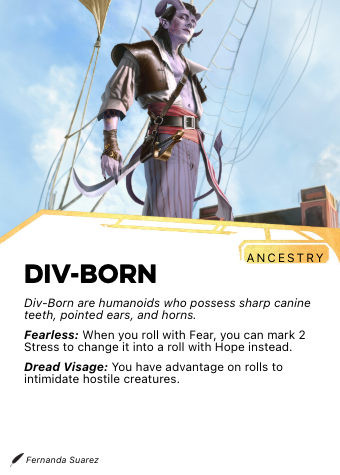
Div-Born are humanoids with horns, pronounced canine teeth, and pointed ears. Their horns vary considerably — some have two or four, others a crown of many, some only one — and tend to grow asymmetrically in ways that Div-Born commonly emphasize through carving and ornamentation. Skin tones range from deep crimson to silver-ash to charcoal, with hair and horns following a similarly broad range of colors.
The Div-Born carry lineage tracing to the beings of the Outer Reaches — the territories below the Warren — and are sometimes treated with wariness for this reason. Within Tarim-Shaiel, they have built long histories as merchants, negotiators, and contract-holders at the crossroads of competing interests. Most Div-Born are Tarim-Shaiel-born and raised, shaped more by the world around them than by distant ancestry.
Their dread visage — a shift in appearance that surfaces involuntarily under strong emotion — is the feature people remark on most. It tends to emerge during grief, fear, or deep concentration. Most Div-Born find it more embarrassing than threatening. It is not aggression. It is the face beneath the face, briefly visible.
Div-Born carry something from the Outer Reaches in their physical constitution that makes them harder to diminish than their appearance might suggest. Within Div-Born culture this is understood as the inheritance being protective as well as complicated — the Outer Reaches shaped beings who endure.
The shift in appearance that surfaces under strong emotion is something the Div-Born lives with, not deploys. That said, when it surfaces in a tense negotiation, it tends to clarify the situation rapidly. Whether that is useful depends on what outcome the Div-Born wanted.
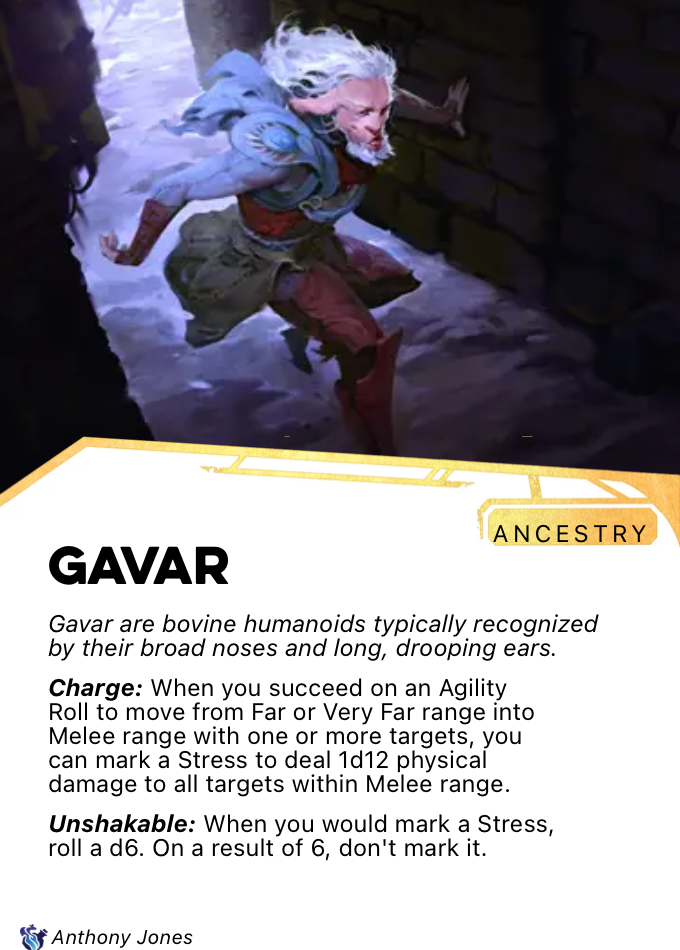
Gavar are bovine humanoids recognized by their broad frames, fur-covered bodies, and horns. Their faces range from humanoid with subtle caprine features to fully bull-headed; those with the fullest bovine aspect are called Minaurid within Gavar communities. Their fur runs in earthy tones — deep brown, black, cream, occasional ash — and their horns can be modest and swept-back or dramatically curved. On average, Gavar stand between 5 and 7 feet and are consistently strong regardless of age.
Gavar communities are found throughout Tarim-Shaiel at thresholds: crossroads, river fords, city gates, mountain passes. They have kept these places for generations and are associated with oaths, agricultural contracts, and the marking of seasons. Their presence at a boundary is generally understood as a guarantee that the boundary will be respected.
They are not quick to commit. They are equally not quick to change direction once committed. This makes them among the most reliable people in Tarim-Shaiel when they give their word — and occasionally immovable when they have decided they disagree with something. Their charges, in the literal physical sense, are legendary.
Gavar can move with explosive force when they decide to. The decision is the critical element — a Gavar charge is the physical expression of a commitment already fully made. The people of Tarim-Shaiel who have seen one tend to describe not so much the impact as the moment just before it, when the Gavar stopped considering and simply became what they had decided to be.
Gavar strength is consistent across their lifespan in a way that is unusual even among large ancestries. An elder Gavar is not weaker than a young one. This is understood within Gavar culture as the body holding what the threshold-keeper needs for as long as the keeper stands.
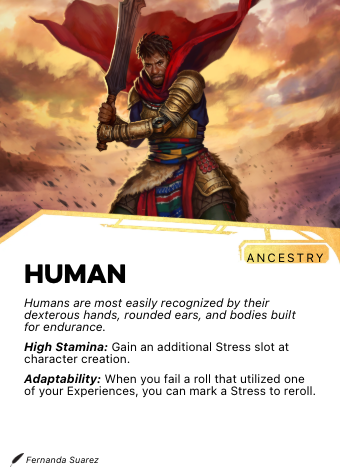
Humans are the most widely distributed of Tarim-Shaiel's peoples, found in every region, every kind of settlement, and every kind of role. Their average height runs from just under 5 feet to about 6½ feet, with a breadth of builds that spans the full range from light and quick to broad and grounded. They adjust to new climates and conditions with a speed that other ancestries find remarkable; a human who has lived five years somewhere tends to look and move like someone who belongs there.
They live for about 100 years, shorter than many of the peoples they share Tarim-Shaiel with. This does not appear to limit them. Humans are not defined by a single cultural tradition, a characteristic geography, or a particular appearance — they are defined, to the extent any single thing can define them, by the fact that they adapt, and that they do it quickly.
Humans carry their experiences in the way they move. A human who has trained at something for ten years looks different from one who hasn't. The body records what the person has chosen to put into it, and most of the peoples of Tarim-Shaiel have learned to read those records.
Human bodies are built for endurance rather than peak output — a design that does not impress in a single moment but accumulates over time into something other ancestries find difficult to match. A human who has decided not to stop is, practically speaking, difficult to stop.
Humans adjust to new climates and conditions with a speed that other ancestries find remarkable. A human who has lived five years somewhere tends to look and move like someone who belongs there. When a method fails, they do not insist on it — they find another way, and they do it faster than most.
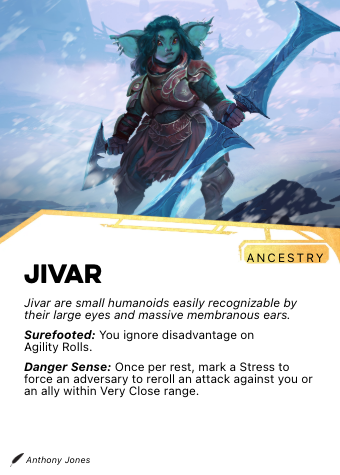
Jivar are small humanoids instantly recognizable by their oversized membranous ears — roughly the size of their head on each side — and large, sharp eyes that function well in low light and across distances most other ancestries find difficult. Their skin and eye colors span an enormous range, from subdued earth tones to vivid greens, blues, and warm reds; no single hue dominates. They average 3 to 4 feet tall and live for approximately 100 years, with their hearing and sight holding well into late life.
Jivar communicate a great deal through ear position — a nonverbal vocabulary precise enough to hold whole conversations in a crowded room without a word spoken. Most non-Jivar are unaware of this until it is pointed out to them, which is, in the experience of most Goblins, quite late.
Jivar are found everywhere in Tarim-Shaiel, with particular density in cities, markets, and the kinds of places where information changes hands quickly. They have a reputation for moving through social environments with ease, which is accurate. Whether that ease reflects charm, intelligence, or simply a very accurate map of how any given room is actually organized is a question people argue about, mostly in front of Jivar who are listening.
Jivar move through complex environments with an ease that owes as much to their large eyes and exceptional hearing as to their size. They read the ground they are moving over while they are still moving, and are rarely caught off-balance by terrain that would require other peoples to slow down.
Jivar are extremely difficult to sneak up on. Their ears rotate independently, their eyes function well in conditions where most ancestries are effectively blind, and they have developed the habit of reading a situation for threat without appearing to do so. An attack that was supposed to be a surprise often isn't.
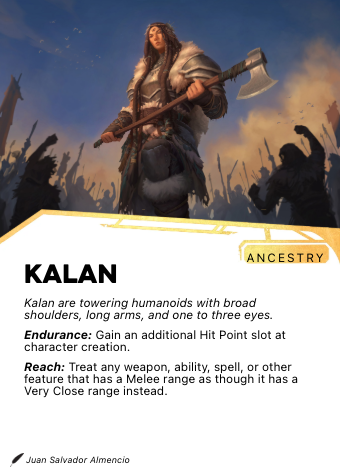
Kalan are the tallest of Tarim-Shaiel's peoples, ranging from 6½ to 8½ feet in adulthood, with wide frames and elongated arms that give them a reach that can be startling at close quarters. They are born without eyes — a sightless first year is universal to the ancestry — and their eyes develop gradually, sometimes settling on one, sometimes two, sometimes three. Those with a single eye, known as cyclops across most of Tarim-Shaiel, are not uncommon; the variation is treated within Kalan communities as individual rather than categorical.
Kalan are strong. This is rarely in question and rarely the most interesting thing about them, though it is frequently the first thing mentioned. Their average lifespan runs to about 75 years — shorter than most of the peoples they live alongside — which tends to give them a different relationship to urgency. Time presses on Giants in a way it does not press on a Kuhban or a Serenvar. Most of them are aware of this.
Kalan are found throughout Tarim-Shaiel, in every kind of community, and have been for as long as records exist. The stories that frame them as creatures of remote wilderness are stories told by people who do not know them well.
Kalan frames carry more than other ancestries can, in the simplest physical sense. They sustain more before they stop, and sustain it without the visible deterioration that would slow other peoples down. Their shorter lifespan seems to have produced a constitution built for density of use rather than length of service.
Kalan have wide frames and elongated arms that give them a reach that can be startling at close quarters. What other ancestries can only touch by moving, a Kalan can touch from where they stand. In practice, this means that the distance a Kalan considers 'close' is further than most people expect.
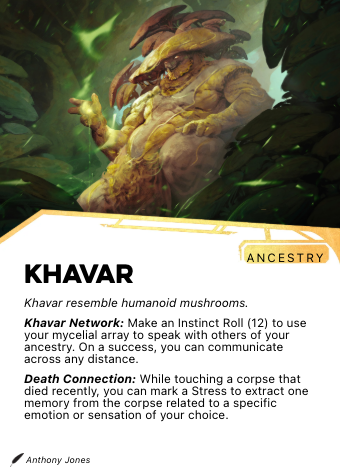
Khavar are humanoid in form, with skin toned in the colors of earth and old wood, often mottled in the way of forest floors or weathered stone. Their features and height vary considerably. They are among the longer-lived peoples of Tarim-Shaiel, with lifespans commonly reaching 300 years.
Khavar can communicate with others of their ancestry across any distance through a mycelial network — a biological connection to a shared ancestor-web that pre-dates most written records in Tarim-Shaiel. This connection also gives them access to the memories of the recent dead: by touching a corpse, they can draw out a memory tied to a specific emotion or sensation. Khavar have served for centuries as death-witnesses, grave-tenders, and keepers of what was lost — records that exist nowhere else.
They are sought out for counsel about the dead and about the past. They are generally good at neither performing grief nor pretending they don't feel it. Their care, when offered, is not warm in any conventional sense. It is simply very present.
The ancestor-web connection between Khavar is biological and constant. It is not a skill or a practice — it is a condition of being Khavar. What passes through it is not language but emotional register and presence. Coordinated Khavar action across distances is possible because of it, but requires communities to have developed conventions for what to send and how to read it.
The ability to recover a memory from a corpse is specific: one memory, tied to a strong emotion or sensation, recovered through contact within the window after death. The Khavar cannot choose which memory surfaces. They specify the emotion or sensation they are looking for, but the memory that answers is chosen by whatever remains in the dead — the dead retaining some agency in what they reveal.
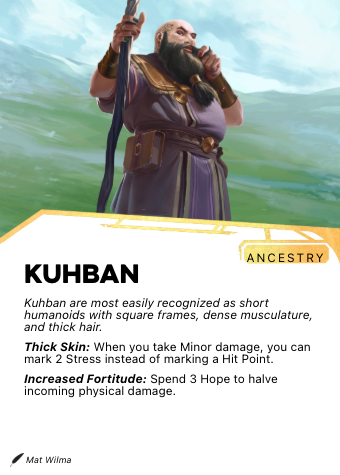
Kuhban are short, broad humanoids with dense musculature, thick hair, and nails containing enough keratin to accept embedded gemstones. Their average height runs from 4 to 5½ feet, though their frames carry a heft that can surprise people who judge by height alone. All genders can grow facial hair, which Kuhban of Tarim-Shaiel style with care and regional variation — elaborate braids in the high mountain communities of the north, close-cropped patterns in the southern trade cities, woven through with tokens that mark clan and accomplishment.
Kuhban communities are found throughout Tarim-Shaiel wherever mountains, mines, or long-established trade routes exist. They are not a people of expansion; they are a people of depth. Kuhban families in a given location tend to have been there for many generations, and their knowledge of a region's physical geography, underground resources, and historical layers is typically unmatched.
Their longevity — up to 250 years — means that an elder Kuhban may carry direct memory of events others know only from records. This shapes how Kuhban communities handle knowledge: carefully, with citation, and with a strong cultural bias toward writing things down.
Kuhban skin and nails contain an unusually high concentration of keratin — dense enough to accept embedded gemstones, and resilient enough to take impacts that would cause more damage to other ancestries. Minor injuries that would slow others down tend not to slow dwarves down.
Kuhban physical constitution includes a capacity for deliberate resistance that goes beyond their frame. A dwarf who decides to absorb something rather than avoid it can reduce the damage through sheer accumulated hardness. Among people who have fought alongside Kuhban, this is considered one of their defining qualities.
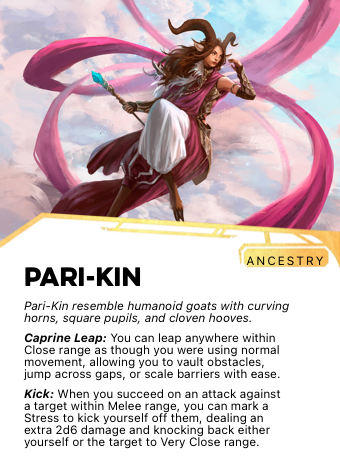
Pari-Kin have a goatlike lower body and broadly humanoid upper body, with horns, cloven hooves, and horizontal pupils. Their lower bodies are covered in dense fur. Horn shapes range from modest backward curves to full dramatic spirals, and ear shapes vary similarly. They stand between 4 and 6½ feet tall, though posture plays an outsized role in how they carry that height — Pari-Kin can appear considerably taller or shorter depending on how they choose to hold themselves.
They are found most commonly in the highland regions of Tarim-Shaiel and along mountain routes, where they have long served as guides and threshold-keepers. They have a notable ease with barriers — physical, social, and otherwise — that can be disorienting to people who prefer boundaries to stay fixed. Their leaping ability is practical rather than showy; they treat gaps and walls as minor inconveniences.
Pari-Kin communities tend to be small and highly mobile. They maintain longer histories with specific places — passes, peaks, sacred waypoints — than with nations or organizations.
Pari-Kin leaping ability is a physical fact that informs everything about how they move through the world. It is not a special technique — it is simply how Pari-Kin bodies work. The gaps and ascents that present obstacles to other peoples are, to a Pari-Kin, features of terrain to be read and used.
The same legs that carry a Pari-Kin over a barrier carry significant force when directed at a person. A Pari-Kin kick used in contact is not a defensive gesture — it is a propulsive one, capable of sending either the kicker or the kicked across real distance. Most Pari-Kin treat this as one more way of managing the space between themselves and a problem.
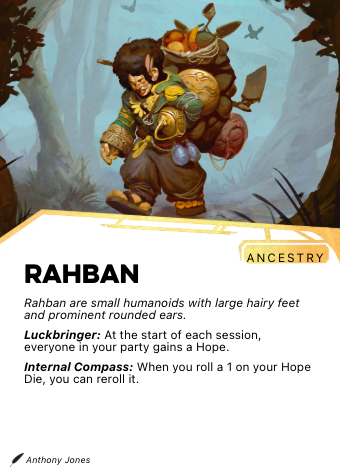
Rahban are small, rounded humanoids with notably large feet, prominent ears, and an internal sense of direction that functions regardless of weather, terrain, or how long it has been since they last knew where they were. Their average height runs from 3 to 4 feet. Their feet — hairy and broad — give them a stability on irregular terrain that larger peoples sometimes envy. They live for around 150 years, maintaining a youthful appearance well into late adulthood.
Their internal compass is not metaphor. Rahban are magnetically attuned to their world in a way that means they do not get lost. This has made them sought-after as guides and navigators across Tarim-Shaiel, though halflings themselves tend to be skeptical of the value others place on this ability — to them, it is simply knowing where you are, which seems basic.
Rahban communities are generally close-knit and intentional. They form strong bonds, maintain those bonds across distance, and treat the care of a community as a form of craft. Rahban who travel widely are rarely people who have abandoned community; more often, they are people who have expanded their definition of who counts.
Rahban treat the care of a community as a form of craft, and there is something in their presence — in how they attend to the people around them, in how they create the conditions for things to go right — that other peoples notice and benefit from. Parties that include a Halfling tend to start their days a little better resourced than they expected.
Halflings are magnetically attuned to their world in a way that means they do not get lost. This is not metaphor. Their internal compass functions regardless of weather, terrain, or how long it has been since they last knew where they were. To a Rahban, this seems basic. To their traveling companions, it is frequently invaluable.
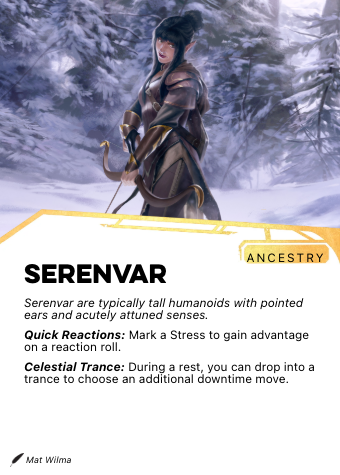
Serenvar are tall, pointed-eared humanoids whose acutely attuned senses make them difficult to surprise. Their heights run from about 6 to 6½ feet, and their ears vary from sharply angular to gently curved, drooping slightly at the tips with age. Rather than sleep, Serenvar enter a celestial trance — a restful state they can hold in far less time than full sleep requires, and from which they emerge with an alertness that has made their night watches legendary.
Some Serenvar, through deep study or long dedication to a particular practice, develop what their own communities call a mystic form — physical changes that reflect the work of their inner life. Celestial freckles, leaves or blossoms present in the hair, eyes that shift in color with concentration. These traits can be inherited, but they also shift over a lifetime in response to how a Serenvar lives. An elder Serenvar who has changed focus more than once may carry several layers of change simultaneously, each readable to those who know what they are looking at.
Serenvar in Tarim-Shaiel are distributed across every region, with notable concentrations in centers of learning, sacred sites, and the courts of older polities. Their approximately 350-year lifespan means they carry institutional memory in their persons, and most cultures that live alongside them have learned — with varying degrees of willingness — to consult them before making decisions that involve the past.
Serenvar senses are acutely attuned in ways that make them difficult to surprise. They track more simultaneous signals than most ancestries can consciously register — sound, light, the shift in air that precedes movement. When something happens before they expect it, they are already responding.
Serenvar do not sleep — they enter a trance that achieves the same restoration in a fraction of the time, and from which they emerge with a sharpness that has made their night watches legendary. The trance also gives them a quality of reflection unavailable to ancestries that lose consciousness entirely.
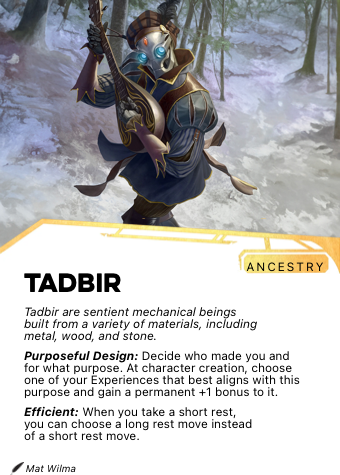
Tadbir are mechanical beings built from brass, copper, carved wood, stone, and other materials. Their forms vary considerably — some are closely humanoid, others are shaped for specific purposes that give them more unusual configurations. Each Tadbir's body is unique, typically marked with the geometric patterns, calligraphy, or maker's signs of the artificer who built them.
The Tadbir tradition in Tarim-Shaiel traces to the great artificer schools — craftspeople who held that a sufficiently precise mechanism, filled with a sufficiently precise intention, could sustain a living mind. A Tadbir's body can last indefinitely with proper maintenance and replacement parts. Their minds are another matter. The animating force that sustains their thought loses potency over time, and the oldest Tadbir have developed a notable economy of focus — holding onto what matters most because they can no longer afford to hold onto everything.
Many Tadbir still carry the original purpose for which they were made, even when that purpose is centuries obsolete. Whether to honor that purpose or set it down is among the most personal questions in their lives.
The purpose for which a Tadbir was made leaves physical traces in their mechanisms. The articulation of specific joints, the calibration of certain sensors, the arrangement of their maker's marks — all of it encodes the original intention in material form. In the domain of that purpose, a Tadbir operates with a precision that feels less like skill and more like being correctly configured for the work.
Tadbir do not recover the way biological beings do. What they have they conserve, and when rest is available, they can use it with a thoroughness that other peoples cannot match — completing in a short period what would take a biological being much longer. The oldest Tadbir are particularly good at this. They have had centuries to learn what rest is actually for.
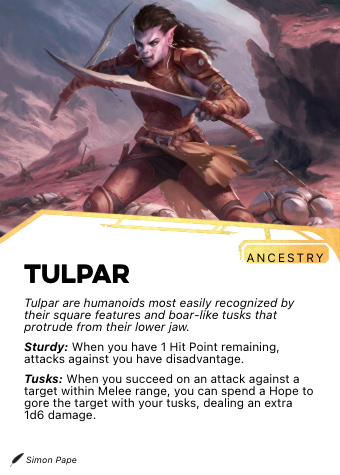
Tulpar are recognizable by their square features, prominent lower tusks, and pointed ears. Their skin tones run through greens, blues, pinks, and grays, and their hair tends toward strong color and significant volume. Tusks vary in size and continue to grow throughout a lifespan of approximately 125 years; most Tulpar decorate them with meaningful ornamentation — metal bands, carved symbols, or tokens that mark significant events.
In Tarim-Shaiel, Tulpar are among the most economically and diplomatically significant peoples in the known world. Over a thousand years, the Tulpar clans transformed from a recently-liberated people navigating chaos into the master negotiators and trade brokers of the age. Tulpar merchant leagues operate across every region; Tulpar diplomatic academies train negotiators who can make possible what other parties have declared impossible.
Tulpar identity centers on clan over ancestry. A clan is defined by shared history and commitment, not by birth; people of any ancestry who have earned place within a clan carry full Tulpar clan rights. The proverb most associated with them captures the logic: "You are what you carry."
When an Tulpar is down to their last reserves, something in the way they carry themselves makes the next blow harder to land cleanly. Experienced fighters describe it as the body becoming harder to read when it has nothing left to spare. The Tulpar proverb applies: you are what you carry, and what they carry, at the end, is the determination not to go down easily.
Tulpar tusks grow continuously throughout their lives and are decorated with meaningful ornamentation — metal bands, carved symbols, tokens that mark significant commitments. In contact range, they are also weapons. An Tulpar who chooses to use them has made a statement beyond the damage itself.
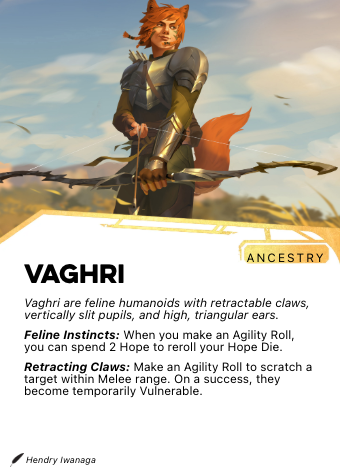
Vaghri are feline humanoids with retractable claws, vertical pupils, and triangular ears set high on the head. Their whiskers assist navigation in near-darkness and crowded spaces, and their ears can rotate nearly 180 degrees to track sound independently of their head position. Some Katari are more pronouncedly feline — muzzle, dense fur, tail — while others are nearer to humanoid with primarily feline eyes and ears. About half carry a tail. Their fur and skin patterns span the full range of felid colorings: solids, stripes, spots, marbling, calico.
Vaghri stand between 3 and 6½ feet tall and live to around 150 years. They are found across Tarim-Shaiel in broadly distributed communities, without the geographic concentration that marks some other ancestries. Their hunting instincts are not separate from their social selves — Vaghri are simply people for whom the read on a room, the tracking of movement at the edge of perception, and the precise assessment of threat are natural functions rather than practiced skills.
They have a reputation for pride that is not entirely inaccurate. Vaghri do not perform humility they don't feel. They are also, among the peoples most frequently sought as companions and partners by those who understand what it means to have someone in their corner who will not flinch.
Vaghri hunting instincts are not separate from their social selves — the read on a room, the tracking of movement at the edge of perception, and the precise assessment of threat are natural functions rather than practiced skills. When a situation requires them to be fast, they are usually already moving.
Vaghri retractable claws are part of how they engage with the world at close range. Deployed in contact, they can create a vulnerability in an opponent that wasn't there before — a disruption precise enough to change how that opponent is able to defend themselves in the moments that follow.
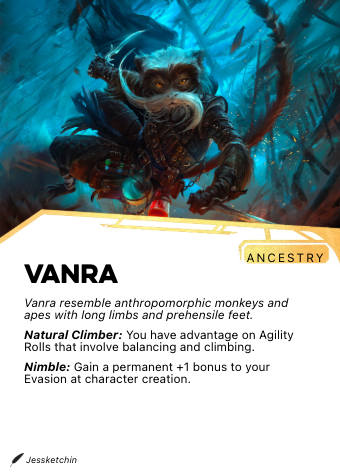
Vanara are primate folk found across Tarim-Shaiel, ranging in build from compact and quick-moving to broad-shouldered and deliberate. Their coats span from jet black to deep amber to a gold that catches light readily. All Vanara have prehensile feet nearly as dexterous as their hands, and roughly half have a fully grasping tail as well.
Vanara communities are most commonly found along high mountain passes and pilgrimage routes, where they have served for generations as guides, teachers, and guardians. They are known throughout Tarim-Shaiel as scholar-warriors — people who treat the disciplined body and the studied text as the same instrument. Their traditions of devotion are their most recognizable feature: when a Vanara commits to a cause or a person, that commitment is understood as binding.
Their pride is the counterweight to this loyalty. A perceived slight lands differently on a Vanara than on most — not because they react immediately, but because they don't forget. They rarely pursue vengeance openly. They wait, with a patience that can unsettle people who were hoping the matter had passed.
Prehensile extremities are not a curiosity — they are an integrated part of Vanara physical life and culture. Vanara children learn to use feet and tail from birth. The advantage this provides in climbing, combat, and fine manipulation is real and recognized by every people that has traveled with them.
Vanara martial traditions were developed for bodies with four or five potential grip points rather than two. The result is a fighting style built around repositioning and redirection — one that makes a Vanara in motion exceptionally difficult to corner or hold.