OVERVIEW
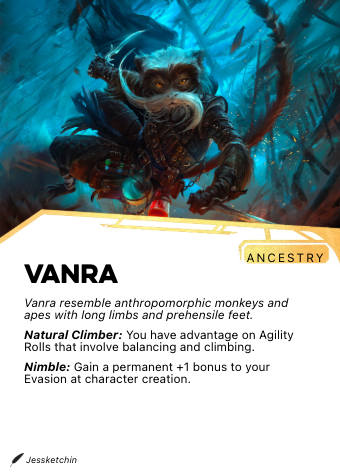
Vanara (Simiah) are primate folk found across Tarim-Shaiel, ranging in build from compact and quick-moving to broad-shouldered and deliberate. Their coats span from jet black to deep amber to a gold that catches light readily. All Vanara have prehensile feet nearly as dexterous as their hands, and roughly half have a fully grasping tail as well.
Vanara communities are most commonly found along high mountain passes and pilgrimage routes, where they have served for generations as guides, teachers, and guardians. They are known throughout Tarim-Shaiel as scholar-warriors — people who treat the disciplined body and the studied text as the same instrument. Their traditions of devotion are their most recognizable feature: when a Vanara commits to a cause or a person, that commitment is understood as binding.
Their pride is the counterweight to this loyalty. A perceived slight lands differently on a Vanara than on most — not because they react immediately, but because they don't forget. They rarely pursue vengeance openly. They wait, with a patience that can unsettle people who were hoping the matter had passed.
HISTORICAL POSITION
Before the Liberation
Vanara predate the liberation as a known presence in Tarim-Shaiel's high places. Long before the liberation, Vanara communities held the mountain passes — not as gatekeepers who extracted toll, but as guardians who understood the routes as sacred obligations. Pilgrimage roads, trade paths, and migration corridors passed through their territories, and the Vanara maintained them: keeping waypoints, marking hazards, mediating disputes between travelers.
The great scholarly traditions most associated with the Vanara — the integration of martial discipline and textual study — had already developed into formal schools at this time. Several mountain academies trace their founding to pre-liberation eras, though the records are fragmentary.
The Liberation Era
When the liberation shook the foundations of Tarim-Shaiel's existing order, the Vanara passes became critical corridors. Newly-freed peoples moved through the high routes in large numbers; Vanara communities found themselves hosting, guiding, and sometimes protecting populations who had no other path forward. This period cemented the Vanara reputation as reliable intermediaries — people whose commitment to a safe passage was not contingent on who was asking.
Vanara martial academies took in students from liberated peoples during this era. The tradition of teaching regardless of ancestry dates to this period and remains a defining feature of Vanara scholarly culture.
The Consolidation and Modern Era
As Tarim-Shaiel stabilized, Vanara communities expanded their role from route-guardians to institutional knowledge-holders. The major mountain academies grew in prestige; Vanara scholars became sought-after teachers in lowland cities as well as highland passes. The modern Vanara are found everywhere learning is valued — but their cultural center of gravity remains the high places.
"The body that cannot climb cannot read. The mind that cannot read has nowhere to climb."
CULTURAL CHARACTERISTICS
The Unity of Practice
Vanara do not separate martial training from scholarly study. Both are understood as disciplines of attention — ways of learning to be present, precise, and accountable to something larger than oneself. A Vanara who only fights is considered incomplete. A Vanara who only reads is considered the same.
This unity manifests practically: Vanara academies teach combat and text in alternating sessions. Students who resist one half of the curriculum are counseled out. The philosophy is not that every Vanara must be equally skilled at both, but that the practice of each must inform the other.
Devotion as Contract
When a Vanara commits — to a cause, a person, a community, a duty — that commitment is understood within Vanara culture as a formal bond. Not legally binding in any court's terms, but morally absolute in Vanara reckoning. A Vanara who breaks such a commitment without extraordinary cause faces lasting social consequences within their community.
This makes Vanara loyalty genuinely remarkable, and genuinely sought. It also makes betrayal by someone a Vanara was devoted to one of the most serious wounds they can suffer — not merely personal, but a violation of something they considered sacred.
The Long Memory
Vanara do not forget slights, and they do not rush to settle them. The combination of a long lifespan (Vanara commonly reach 150 years), a cultural emphasis on patience as a virtue, and a deep sense of personal honor means that a Vanara who has been wronged will wait for the right moment rather than the immediate one.
This is not a reputation they cultivate for effect. It is simply accurate. Other peoples who have dealt extensively with Vanara learn to take their silences seriously.
Physical Integration
Vanara are not merely humanoids who happen to have prehensile feet and optional tails — these features are integrated into Vanara physical culture in ways that outsiders often find disorienting. A Vanara in conversation may have their feet occupied with something entirely different from their hands. A Vanara with a grasping tail treats it as a third hand, not an accessory.
This is most visible in Vanara martial traditions, which were developed for bodies with four or five potential grip points rather than two. Vanara fighting styles are not easily replicated by other ancestries for this reason.
ECONOMIC AND SOCIAL ROLE
Route guidance and safety, scholarly instruction, martial training, mediation at mountain crossroads, archival work at major pilgrimage sites.
Vanara scholars hold positions in most of Tarim-Shaiel's significant centers of learning. They are not dominant in any single institution, but their presence is consistent — they are among the few peoples whose scholars travel freely between rival scholarly traditions without being perceived as taking sides.
Vanara academies are among the few institutions that will instruct students of any ancestry in advanced combat forms. This has made them important contributors to the military capacity of several polities that lack indigenous martial traditions at the same level.
Vanara are not primarily merchants, but the mountain routes they manage are economically significant. A Vanara guide's guarantee that a pass is safe carries real market value — caravans pay premium rates for Vanara escort through difficult terrain.
FEATURES IN THE WORLD
What Daggerheart's Simiah mechanics mean inside Tarim-Shaiel — no game-system references.
Not a curiosity — an integrated part of Vanara physical life and culture. Vanara children learn to use feet and tail from birth. The advantage this provides in climbing, combat, and fine manipulation is real and recognized by other peoples.
Vanara can form a commitment to a person that sharpens their performance when that person is at risk. Within Vanara culture this is understood as the body expressing what the spirit has already decided. It is not consciously activated — it is a consequence of what a Vanara is when they have truly committed to someone.
A genuine slight to a Vanara's honor — particularly one that undermines their competence, their loyalty, or their word — activates something that Vanara themselves describe as a narrowing of the world. They become less careful, more direct, and occasionally more dangerous. The cultural pressure to respond with patience rather than immediacy is strong, but it is not always sufficient.
RELATIONS WITH OTHER ANCESTRIES
Strong mutual respect built over the liberation era. Tulpar clans moving through mountain routes in the chaos period found Vanara guides who did not demand proof of worthiness before helping. Several major Tulpar clan histories include named Vanara who made a critical difference. The relationship is not uniformly warm — Vanara find Tulpar pragmatism occasionally at odds with Vanara ideas of honor — but the foundation is solid.
The most common students at Vanara academies are human, for the simple reason that humans are the most numerous people in Tarim-Shaiel. Vanara instructors have complex feelings about this — appreciation for the resource it represents, occasional frustration with students who want the credential without the discipline. The best Vanara-human relationships are teaching bonds that last decades.
Natural alignment at thresholds. Both peoples understand the holding of a boundary as a sacred obligation rather than a commercial one. Vanara and Gavar communities co-manage several major mountain crossroads, with a division of labor that has evolved organically: Gavar hold the gates, Vanara hold the roads.
Mutual curiosity. The Tadbir relationship to purpose — carrying an original function across centuries — resonates with Vanara ideas about devotion. The practical collaboration is less obvious, but Vanara scholars and Tadbir have worked together at several major archives.
[NEEDS REFINEMENT — see Development Notes] A significant relationship that requires dedicated treatment. Kuhban hold the interior of the mountain; Vanara hold the surface routes. Complementary niches with real friction over who speaks for the mountain itself.
PLAYER CHARACTER HOOKS
Questions for a Vanara (Simiah) PC
1. Who are you devoted to? Vanara devotion is not casual. If you carry it for someone, what did they do — or what are they — that earned it? And do they know the weight of what you've given them?
2. What did you not forget? The long memory is not only about vengeance. It holds loss, kindness, and the specific texture of things that mattered. What are you still carrying from years ago that you have never fully set down?
3. What is the relationship between your body and your mind in your own life? The unity of practice is a Vanara ideal — not every Vanara achieves it, and not every Vanara wants to. Where do you sit on that question?
Character Concepts
- The route-keeper who left the pass: A Vanara who held a mountain road for thirty years and then walked away. The road is still there. The question of why they left is not settled.
- The devoted, late: A Vanara whose commitment bond was to someone who died. The bond didn't end. They are not sure what to do with what they still carry.
- The student who was failed by a teacher: Vanara academic culture produces excellent scholars and occasionally produces people who were betrayed by an institution they trusted completely. This Vanara knows the difference between the ideal and the reality, and is still deciding what that knowledge obliges them to do.