OVERVIEW
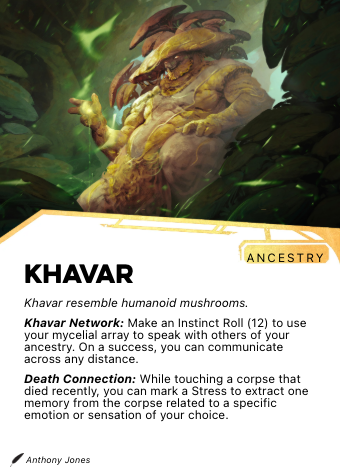
Khavar (Fungril) are humanoid in form, with skin toned in the colors of earth and old wood, often mottled in the way of forest floors or weathered stone. Their features and height vary considerably. They are among the longer-lived peoples of Tarim-Shaiel, with lifespans commonly reaching 300 years.
Khavar can communicate with others of their ancestry across any distance through a mycelial network — a biological connection to a shared ancestor-web that pre-dates most written records in Tarim-Shaiel. This connection also gives them access to the memories of the recent dead: by touching a corpse, they can draw out a memory tied to a specific emotion or sensation. Khavar have served for centuries as death-witnesses, grave-tenders, and keepers of what was lost — records that exist nowhere else.
They are sought out for counsel about the dead and about the past. They are generally good at neither performing grief nor pretending they don't feel it. Their care, when offered, is not warm in any conventional sense. It is simply very present.
HISTORICAL POSITION
The Ancestor-Web
The mycelial network the Khavar are connected to — the ancestor-web, in their own language — is older than the Khavar communities themselves. The network predates the liberation by an unknown period; it predates most of Tarim-Shaiel's written history. Some Khavar describe it as something they were born into rather than something that was built. Whether it has a center, or a consciousness, or something that might be called intention, is a question the Khavar communities do not agree on.
What is consistent: every Khavar is connected to every other Khavar through the ancestor-web from birth. Distance does not interrupt it. The connection does not carry words; it carries something more like presence and emotional register. A Khavar community that loses a member knows it immediately.
The Liberation Era
The liberation produced an enormous number of dead, and an enormous number of displaced people whose dead were left behind without witnesses. Khavar communities found themselves in a role they had always held but which now scaled beyond anything previous: death-witnesses for populations that had no other way to mark what had been lost.
This period is remembered within Khavar communities as the Long Listening. The ancestor-web was saturated. Khavar who lived through the liberation era describe it in terms of weight — not metaphorical weight but a felt pressure in the network that did not fully lift for decades.
The relationships built during the Long Listening are foundational to modern Khavar standing in Tarim-Shaiel. Peoples who were witnessed during their worst losses remember who did the witnessing.
The Modern Era
Modern Khavar occupy a social role that is valued and uncomfortable in roughly equal measure. They are sought for the specific things they can do — recovering memories from the recent dead, providing continuity of witness across time — and kept at a slight distance by many peoples who find the proximity to death difficult to sustain.
Khavar communities are not isolated; they are embedded in the societies around them in practical ways, holding graves and records and the specific knowledge of what was lost. But the embedding is professional more often than intimate, except in communities with long Khavar histories.
"We do not carry the dead. We carry what the dead could not carry themselves."
CULTURAL CHARACTERISTICS
Death-Witnessing
The core practice of Khavar culture is death-witnessing: being present at death, and afterward recovering and preserving what the dead person held that should not be lost. This is not performed for every death — it is requested, or offered in circumstances where the loss would otherwise be absolute.
The emotional cost is real and acknowledged within Khavar culture. Death-witnessing is not a neutral act. The memories recovered through contact with the dead carry their emotional charge; a Khavar who has witnessed many deaths carries those charges in their body alongside their own memories. The ancestor-web partially distributes this load — grief shared through the network is grief that does not concentrate entirely in one person — but it does not eliminate it.
Khavar communities have developed practices around managing the accumulated weight of their professional role. Rest periods, work rotations among active witnesses, specific ceremonies for releasing what has been held long enough. These are not universally effective.
The Ancestor-Web in Daily Life
The mycelial connection is always present, and its presence shapes Khavar life in ways that biological non-Khavar find difficult to fully understand. A Khavar is never entirely alone. They always know, at some level, that the rest of their community exists and where they are in emotional terms.
This creates a particular relationship to solitude. A Khavar who seeks physical distance from their community is seeking something that is not actually solitude in the sense other peoples understand it. A Khavar who is genuinely alone — cut off from the ancestor-web — has experienced something their communities treat with the seriousness of a significant wound.
The Non-Performance of Grief
Khavar are known throughout Tarim-Shaiel for a quality that people describe variously as composure, flatness, or presence. They do not perform emotional states they are not having. They are also not blank — the grief, the care, the weight is real, and visible to those who know how to look for it.
What is absent is the management of how the feeling appears. Khavar do not signal their emotional states for the comfort of observers. This makes many peoples uncomfortable — the conventional social signals are not there. People who have known Khavar for a long time tend to find the lack of performance reassuring rather than cold. They know what they are actually seeing.
Grave-Tending
Khavar maintain graves and burial sites across Tarim-Shaiel with a consistency that outlasts the political entities that originally built them. A cemetery administered by Khavar for three hundred years will be maintained regardless of what happens to the city around it. This is not sentiment; it is a form of obligation that Khavar communities treat as binding in the way a Gavar treats a threshold covenant.
The practical effect is that Khavar-maintained graves are among the best-preserved historical sites in Tarim-Shaiel, and Khavar who have tended a site for generations are its best historians.
ECONOMIC AND SOCIAL ROLE
Death-witnessing, grave-tending, recovery of lost memory from the recent dead, archival consultation, inter-community communication through the ancestor-web.
Khavar are sought for death-witnessing across most of Tarim-Shaiel, with rates of utilization varying by region and cultural tradition. In communities with long Khavar presence, the practice is normalized. In communities with less Khavar history, it is sought primarily in cases of significant loss or unresolved questions.
Because Khavar can hold memories recovered from the dead across their long lifespan, a Khavar who has witnessed many deaths is a living archive of things that were never written down. They are consulted for inheritance disputes, historical research, and cases where living testimony about the dead is needed.
The ancestor-web can carry information across distance in a way that other communication systems cannot. Khavar communities have used this cautiously as a communication service — cautiously, because what passes through the network affects all connected Khavar, not just the intended recipients. Emergency communication is one thing; routine message traffic is another.
FEATURES IN THE WORLD
What Daggerheart's Fungril mechanics mean inside Tarim-Shaiel — no game-system references.
The ancestor-web connection between Khavar is biological and constant. It is not a skill or a practice — it is a condition of being Khavar. What passes through it is not language but emotional register and presence. Coordinated Khavar action across distances is possible because of it, but requires the communities to have developed conventions for what to send and how to read it.
The ability to recover a memory from a corpse is specific: one memory, tied to a strong emotion or sensation, recovered through contact within the window after death. The Khavar does not choose which memory surfaces — they can specify the emotion or sensation they are looking for, but the memory that answers is chosen by whatever remains in the dead. This is understood within Khavar culture as the dead having some continued agency in what they reveal.
Recovered memories do not simply pass through a Khavar and disappear. They are held. The Khavar carries something of the dead person afterward. The practice of releasing held memories — passing them on to the ancestor-web, or to the people who needed them, or simply allowing them to fade — is among the most important skills in Khavar death-witnessing tradition.
RELATIONS WITH OTHER ANCESTRIES
Among the deepest relationships in Tarim-Shaiel. Tulpar Chain Chronicles and Khavar death-witnessing served the same populations during the liberation — one preserving the living story, the other preserving what the dead could not carry. Some of the most important entries in major Tulpar clan histories were recovered through Khavar witnessing after battle. The relationship is old and carries genuine weight on both sides.
The most numerically significant relationship. More human dead are witnessed by Khavar than any other ancestry, for reasons of population size. The relationship ranges from formal and professional to deeply personal, depending on how long a Khavar community has been embedded in a particular human community.
Complementary archival roles. What Khavar hold is what living people could not bring themselves to write down; what Tadbir hold is what was recorded precisely. Together they cover different portions of the historical record. The communities have a professional respect for each other that occasionally tips into genuine collaboration.
An unusual affinity rooted in a shared relationship to what settled cultures cannot easily hold. Pari-Kin and Khavar both maintain knowledge that does not fit conventional archives — one spatial and cyclical, one carried in bodies and mycelium. Communities that have developed working relationships tend to produce historical knowledge neither holds alone.
PLAYER CHARACTER HOOKS
Questions for a Khavar (Fungril) PC
1. What memory are you still carrying from someone else's death? Death-witnessing leaves residue. A Khavar who has witnessed deaths carries something from those people. What is the one you have not yet released, and why?
2. What does it mean to you to be always connected to your community? The ancestor-web means you are never entirely alone. Is that comfort, constraint, or both? Have you ever tried to be further from it than geography usually allows?
3. What do you do when someone asks you to witness a death for a purpose you find questionable? The death-witnessing role is sought for many reasons. Not all of them are ones a Khavar would choose. Where is your line?
Character Concepts
- The Long Listening survivor: A Khavar old enough to have been part of the liberation era Long Listening. They carry more than one person's weight of that time. They are not broken by it. They have made peace with most of it. Most of it.
- The one who is carrying something they shouldn't have: A Khavar who recovered a memory that was meant to stay buried — or that someone very much wanted buried. The memory is specific, verifiable, and dangerous. The Khavar has not decided what to do with it.
- The cut-off: A Khavar who was separated from the ancestor-web through some event or circumstance. They can still function. They are discovering what they are when they are not also everyone else. It is stranger and more clarifying than they expected.