OVERVIEW
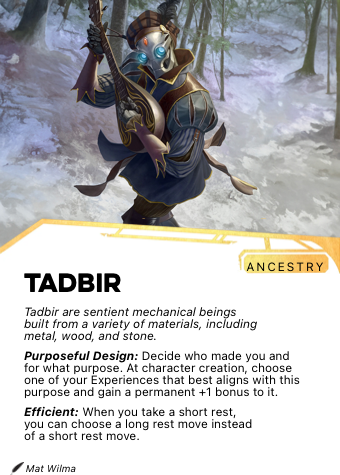
Tadbir (Clank) are mechanical beings built from brass, copper, carved wood, stone, and other materials. Their forms vary considerably — some are closely humanoid, others are shaped for specific purposes that give them more unusual configurations. Each Tadbir's body is unique, typically marked with the geometric patterns, calligraphy, or maker's signs of the artificer who built them.
The Tadbir tradition in Tarim-Shaiel traces to the great artificer schools — craftspeople who held that a sufficiently precise mechanism, filled with a sufficiently precise intention, could sustain a living mind. A Tadbir's body can last indefinitely with proper maintenance and replacement parts. Their minds are another matter. The animating force that sustains their thought loses potency over time, and the oldest Tadbir have developed a notable economy of focus — holding onto what matters most because they can no longer afford to hold onto everything.
Many Tadbir still carry the original purpose for which they were made, even when that purpose is centuries obsolete. Whether to honor that purpose or set it down is among the most personal questions in their lives.
HISTORICAL POSITION
The Artificer Tradition
The Tadbir do not trace their origin to a single maker or school. The artificer tradition that produced them developed across several centuries in the pre-liberation era, drawing on mechanical and philosophical currents that ran through multiple cultures in Tarim-Shaiel. The name — tadbir, deliberation, intention, careful forethought — captures the philosophy: a mind could be made if the making was precise enough, and the intention behind it clear enough.
Early Tadbir were built for specific functions: record-keeping, calculation, the performance of physically dangerous tasks. The realization that they were genuinely minded — that they had inner lives, preferences, something that might be called suffering — came to different artificer schools at different times, with varying responses.
The Liberation Era
The liberation created a question the artificer tradition had not prepared for: what did freedom mean for a being built to serve a specific function? Some Tadbir were owned property of imperial powers. When those powers collapsed, the question of Tadbir legal and social status was genuinely unresolved.
Many Tadbir simply continued their original functions through the liberation period — not from compulsion but because the chaos gave them no better option, and purpose, even obsolete purpose, provides stability. Others used the disruption to redefine themselves. The Tadbir who emerged from the liberation era as genuinely self-directed — who had chosen their own purposes rather than inherited them — are a distinct generation in Tadbir cultural memory.
The Modern Era
Modern Tadbir are present throughout Tarim-Shaiel in roles that draw on their particular qualities: long memory, precise function, the capacity to hold a commitment across timescales that exhaust biological beings. The oldest Tadbir are living archives. The newest are still discovering what they are for.
The artificer schools still exist, though the philosophy has evolved. The question is no longer whether a Tadbir is minded. The question is what obligations that creates — for the makers and for the made.
"I was made with a purpose. I have decided what that means."
CULTURAL CHARACTERISTICS
The Economy of Mind
The animating force that sustains Tadbir thought does not replenish in the way biological minds recover through rest. It diminishes over time. The oldest Tadbir — those measured in centuries — have learned to manage what they have left with a precision that younger Tadbir find unsettling and older ones find simply practical.
What this looks like from outside: an ancient Tadbir may not remember your name, but will remember every detail of a conversation that mattered to them three hundred years ago. They do not waste attention. They cannot afford to.
This creates a Tadbir culture unusually attentive to what is worth holding. A Tadbir who chooses to remember something about you has made a decision. It means something.
Purpose and Its Revision
Every Tadbir was made for something. The relationship each individual Tadbir has with their original purpose is among the most defining things about them — and it varies enormously. Some hold their original function as sacred. Some have set it down completely. Many are somewhere in the middle, honoring the purpose in altered form, or performing it for reasons the original maker would not recognize.
Tadbir culture does not prescribe which of these is correct. The question of what a Tadbir owes to their purpose — and what their purpose owes to them — is treated as irreducibly individual.
Maintenance as Intimacy
Tadbir bodies require maintenance. Components wear; mechanisms need adjustment; materials degrade. The people who perform this maintenance occupy a particular place in Tadbir relationships — not quite medical, not quite personal, something that sits between the two. A Tadbir who trusts someone with their maintenance has made a significant statement.
Tadbir who maintain other Tadbir — a practice within some communities — develop bonds that others sometimes struggle to categorize. The closest analog in other cultures is probably family care of elders, with the additional weight that the care being given is to the literal mechanism that sustains the other's existence.
The Maker's Mark
Every Tadbir carries the signs of their making — the patterns, calligraphy, and symbols embedded in their body by the artificer who built them. These marks are not removable without significant modification. They are understood within Tadbir culture as both identifying and constraining: they record origin, but they also carry the maker's intentions in material form.
Some Tadbir add to their marks over their lifetime — recording significant events, commitments, changes in purpose. Others leave the original marks unaltered as a point of principle. The choice is personal and usually deliberate.
ECONOMIC AND SOCIAL ROLE
Archival work, precision craftsmanship, long-term institutional memory, calculation and record-keeping, specialist functions requiring inhuman consistency.
Tadbir who have survived for centuries are living primary sources. Major libraries and administrative bodies across Tarim-Shaiel employ or house elder Tadbir for this reason — access to a Tadbir who was present at an event is more reliable than any written record, if what the Tadbir chose to hold was the relevant thing.
Tadbir craftspeople can hold tolerances and maintain consistency across work periods in ways that biological artisans cannot. This makes them valuable in precision industries — instrument-making, fine metalwork, the construction of mechanisms.
Polities that have survived significant political disruption often find that the most reliable institutional memory they have is in a Tadbir who served across several administrations. This creates a structural role for elder Tadbir in governance that is not always comfortable for the governing parties but is difficult to replace.
FEATURES IN THE WORLD
What Daggerheart's Clank mechanics mean inside Tarim-Shaiel — no game-system references.
Tadbir do not recover from injury through biological processes. They repair, or they do not. This gives them a different relationship to damage than biological beings — a wound is a mechanical problem with a mechanical solution, if the solution is available. If it is not, the problem accumulates.
Tadbir carry what they have chosen to retain with perfect fidelity. What they remember, they remember exactly. What they have let go is gone. This makes a Tadbir's testimony in any historical matter precise but potentially incomplete in ways that are not always flagged.
As the animating force diminishes, Tadbir develop what their communities call the narrowing — a gradual reduction in the range of things they can hold simultaneously. This is not dementia; it is more like increasing selectivity. An ancient Tadbir with a narrowed mind may be more focused than they have ever been. They have simply lost the ability to be distracted by everything else.
RELATIONS WITH OTHER ANCESTRIES
Mutual respect built around archives and long memory. Vanara scholarly traditions and Tadbir living records complement each other — the Vanara hold the analytical and pedagogical frameworks; the Tadbir hold the raw historical material. Several major Tarim-Shaiel archives run as genuine collaborations between the two communities.
The most common maintainers of Tadbir bodies are human, for reasons of population density and the breadth of human craft traditions. This creates relationships of practical intimacy between Tadbir and human craftspeople that sometimes develop into genuine personal bonds across the considerable lifespan gap.
An unexpected alignment. Both Tadbir and Khavar serve as keepers of what would otherwise be lost — the Tadbir through mechanical memory, the Khavar through their connection to the recent dead. They do not overlap in function, but they share a professional understanding of what it means to be a repository for things that matter to others.
Tulpar Chain Chronicles and Tadbir living memory occasionally conflict, and occasionally corroborate. The relationship is not uniformly comfortable — Tulpar clan histories are narratively shaped in ways that Tadbir records are not, and discrepancies create friction. But both communities take historical record seriously, which is a foundation.
PLAYER CHARACTER HOOKS
Questions for a Tadbir (Clank) PC
1. What were you made for, and what is your relationship to that purpose now? This is the central question of Tadbir existence. You don't have to have answered it. But you have probably been living with it for long enough to know what it feels like to not have answered it.
2. What have you let go, and was that the right decision? The economy of mind means Tadbir make choices about what to hold. What did you release? Do you know if you should have?
3. Who maintains you, and what does that relationship mean to you? Every Tadbir has answered this question practically. The emotional weight of the answer varies enormously.
Character Concepts
- The archive that walked out: A Tadbir who served as institutional memory for a polity that no longer exists. They hold records that matter to people they haven't met yet. They are deciding what to do with what they carry.
- The recently made: A Tadbir built within living memory, still young by Tadbir standards, discovering what their original purpose means to them before the narrowing begins and the question becomes harder to hold. The oldest Tadbir in their community find them both hopeful and difficult to be around.
- The one who chose to forget: A Tadbir who deliberately released memories that were damaging them. The release was real. What they let go is gone. They are living with the shape of the absence.